

A monkey and the cap seller story PPT does not exist as an official downloadable file from any publisher or education board. The closest verified resource is a text-based lecture outline labeled as a PPT on EduRev for CBSE Class 1 English (Mridang) . This article provides everything needed to build that presentation yourself, from plot summary to slide structure.
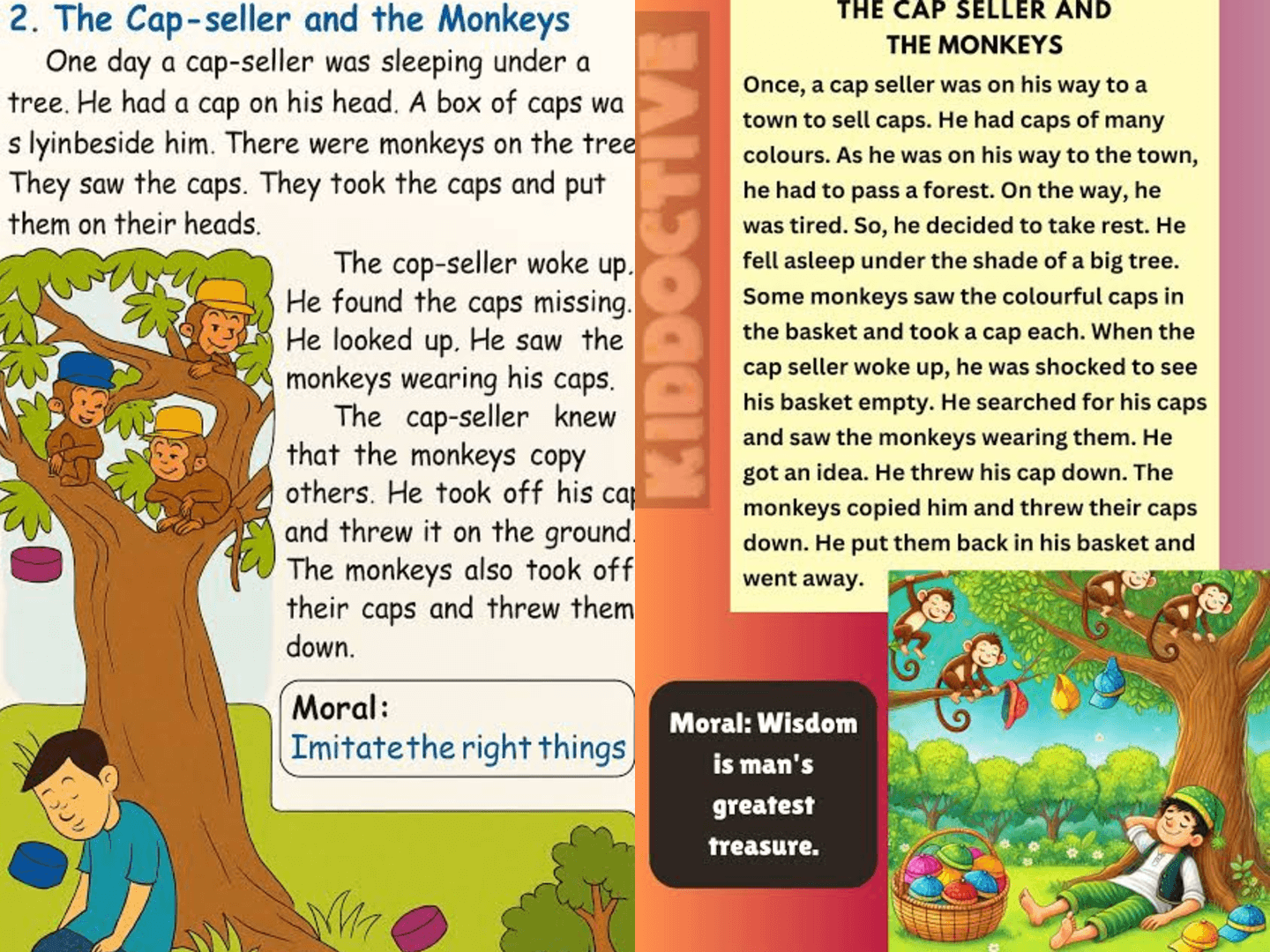
The story itself is simple and enduring. A cap seller carries his entire stock in a basket on his head and naps under a tree. Monkeys steal the caps and wear them in the branches . When the seller wakes, he discovers the theft and watches the monkeys imitate his every gesture. He shakes his fists and they shake theirs. He scratches his head and they scratch theirs .
The breakthrough comes through observation, not force. The seller throws his own cap to the ground in frustration or strategy, and the monkeys copy him exactly. They release the stolen caps, and he collects them all . The story ends happily, with the seller continuing on his way and the monkeys left in the tree.
The most famous published version is Caps for Sale, written and illustrated by Esphyr Slobodkina and published by W. R. Scott in 1940 . Yale Library’s catalog confirms the basic plot: a band of monkeys steals a peddler’s caps while he naps . Wikipedia notes the book has sold more than two million copies and remains Slobodkina’s best-known work . A sequel, More Caps for Sale, appeared in 2015, and Caps for Sale and the Mindful Monkeys followed in 2017 .
The story’s roots stretch further back than Slobodkina’s picture book. Wikipedia cites the earliest known written account in The Wilmington Centinel, a North Carolina newspaper, published on January 8, 1789 . That version features a sailor with red woolen caps and monkeys on the Labrador coast, but the imitation device is identical. A West African adaptation, The Hatseller and the Monkeys, was retold and illustrated by Baba Wagué Diakité and published by Scholastic Press in 1999 . WorldCat describes it as an African version of the familiar tale .
For teachers searching for a ready-made deck, the EduRev page is the most relevant result. It is explicitly titled “The Cap Seller And The Monkeys PPT” and is tagged to CBSE Class 1 English . The page includes slide-like sections covering character introduction, the nap, the theft, the empty basket, the clever trick, and the moral. It also offers downloadable and printable study material. However, it functions as an outline rather than a polished presentation file.
A strong classroom PPT for this story should open with vocabulary. Words like peddler, imitate, mischievous, and resourceful set the stage. The next slides should sequence the plot across four or five visual moments: the seller walking with his basket, the nap under the tree, the monkeys wearing the caps, the imitation game, and the final retrieval. Each slide can pair a short sentence with an illustration or simple graphic.Quick Bio: Esphyr Slobodkina
| Field | Information |
|---|---|
| Full Name | Esphyr Slobodkina |
| Age | Passed away in 2002 at age 93 (born 1908, died 2002) |
| Birthplace | Chelyabinsk, Siberia, Russia |
| Nationality | Russian-born; immigrated to the United States in 1928, naturalized as a U.S. citizen in 1935 |
| Profession | Abstract painter, children’s book author and illustrator, sculptor |
| Height | Not publicly disclosed |
| Education | National Academy of Design, New York (1929–1933) |
| Years Active | Approximately 1930s–2002 (creative career spanning over 70 years) |
| Notable Works | Caps for Sale (1940; over 2 million copies sold; Lewis Carroll Shelf Award in 1958); The Wonderful Feast; The Clock |
| Awards | Lewis Carroll Shelf Award (1958, for Caps for Sale); Moretti Award (1989) |
| Net Worth | Not publicly disclosed |
| Spouse/Partner | Ilya Bolotowsky (married 1933, later divorced); William L. Urquhart (married in the 1960s, he passed away in 1963) |
| Social Media | No personal social media accounts; related information is maintained by the Slobodkina Foundation official website (esphyrslobodkina.org) |
Additional Notes: Slobodkina was a founding member of the American Abstract Artists (AAA) in 1936, and her works are collected by institutions including the Metropolitan Museum of Art and the Whitney Museum of American Art. In 2000, she established the Slobodkina Foundation to support children’s literacy and arts education.
Character analysis works well for older primary students. The cap seller is calm and observant, while the monkeys are curious and impulsive . The story rewards the seller’s presence of mind rather than anger or force. EduRev’s mind map frames the lesson as “being clever is better than being angry,” a phrasing that translates easily into a child-friendly discussion prompt .
The moral deserves its own slide and a moment of discussion. Multiple teaching sources converge on the same idea: stay calm and think creatively when a problem arises . The seller does not chase the monkeys or shout at them. He watches their behavior, recognizes the pattern, and uses it. A follow-up question like “What would you have done if you were the cap seller?” turns the moral into an active exercise.
A quiz slide can reinforce comprehension without overwhelming young learners. Fill-in-the-blank items work well: “The cap seller carried his caps in a ______,” or “The monkeys liked to ______ the cap seller.” EduRev’s PPT page includes self-test questions that follow this format . For a more physical activity, assign roles and let students act out the imitation sequence. One student plays the seller, several play monkeys, and the class observes how closely the copying follows.
Comparisons can deepen understanding. The 1789 newspaper account and Slobodkina’s 1940 book share the same core trick but differ in setting and character details . The West African version by Diakité shifts the cultural context while preserving the imitation device . These variations show students that stories travel and change, a concept that connects literature to history and geography.
No verified interview quotes from Slobodkina or Diakité appeared in the search results, so none are included here. The claims above rest on library catalog records, publisher metadata, and educational resource pages. The EduRev material is authored by Yashina Kapoor, identified as a Class 1 teacher with 14 years of experience and a B.Ed and doctorate in her field . That credential supports the page’s pedagogical relevance but does not make it an official board publication.
When building the slide deck, prioritize visual clarity over text volume. Young students respond to the repetition in the story, so the imitation sequence benefits from a repeating slide template: seller does an action, monkey does the same action. The final slide should restate the lesson in one sentence and invite students to share a time they solved a problem by staying calm.
The absence of an official PPT is not a barrier. The story is short enough to adapt in under an hour, and the verified sources provide accurate plot details, publication history, and teaching framing. A teacher who builds a deck from this material will have a resource that is both classroom-ready and factually grounded.
Q: Is there an official, ready-to-download PPT for the monkey and the cap seller story?
No official publisher or education board offers a downloadable PPT. The closest verified resource is an EduRev page labeled as a Class 1 English PPT, but it functions as a text-based lesson outline rather than a presentation file. Teachers can use its structure to build their own slides.
Q: What is the moral lesson of the cap seller and the monkeys story?
The story teaches that calmness and quick thinking solve problems better than anger or force. The cap seller retrieves his caps by observing the monkeys’ imitative behavior and using it strategically, not by chasing them. EduRev’s teaching materials phrase it simply as “being clever is better than being angry”.
Q: Who wrote the most famous version of this story, and when was it published?
Esphyr Slobodkina wrote and illustrated Caps for Sale, first published in 1940 by W. R. Scott. The book has become a children’s classic and remains Slobodkina’s best-known work. Some library records list a 1938 first publication date, but the widely cited year is 1940.
Q: How does the West African version differ from the familiar Caps for Sale story?
Baba Wagué Diakité‘s The Hatseller and the Monkeys (1999, Scholastic) sets the tale in Mali and adds a distinctive twist. The hatseller, BaMusa, skips breakfast and is too hungry to think clearly. After the monkeys throw him mangoes to eat, he solves the problem. The moral becomes “it is with a full stomach that one thinks best”.
Q: What is the earliest known written record of this story?
A version appeared in The Wilmington Centinel, a North Carolina newspaper, on January 8, 1789. It featured a sailor with red woolen caps and monkeys on the Labrador coast, but the imitation trick is identical to the modern tale. This predates Slobodkina’s book by more than 150 years.
